EMT Practice Test

1. Question Content...


Question List

Question1: Which permission should be granted to a user with Administrator permission and with no access to the
encrypted VM console?

Question2: A vSphere Administrator has multiple virtual machines running on a VMFS datastore.
Which option prioritizes the disk access for the virtual machines?

Question3: An administrator runs a vSphere cluster containing database VMs with extremely heavy disk I/O. Database
VMs are placed on a costly all-flash array. The workloads are not memory intensive.
How can the administrator ensure the most cost-effective utilization of the all-flash storage array?

Question4: Which two VMware solutions track and analyze the operation of multiple data sources? (Choose two.)

Question5: An administrator manages a cluster containing Production and Test VMs. Production VMs run on a VSS
port group and a storage array separate from the Test VMs. The administrator wants to prevent large
(>500GB) file transfers in Test from impacting Production.
Which two configuration changes should the administrator make to achieve this? (Choose two.)

Question6: What should be installed on a VM to enhance performance and enable additional features?

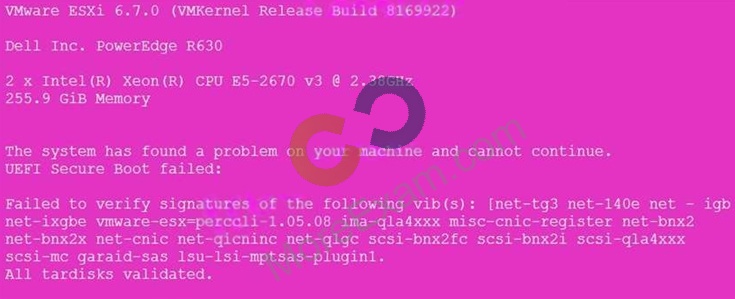
Question7: Refer to the exhibit.
What is required to fix the PSOD?
Question8: An administrator needs to identify where the VM encryption settings are stored.
Which file stores the encryption setting?

Question9: A vSphere administrator needs to migrate VMs in the same vCenter from New York to California due to
impending severe weather.
Which migration should the administrator perform without causing VM downtime?

Question10: For security reasons the VMware vSphere Update Manager (VUM) has no Internet access.
What can be used to provide a central shared repository in a DMZ?

Question11: How is vCenter HA different from vSphere HA?

Question12: Which migration technique could be used to move a VM between vCenters while the VM is powered on?

Question13: An administrator is concerned about the amount of time the IT team takes to create multiple VLANs in a
very dynamic vSphere environment. The environment has these parameters:
All virtual networking utilizes vSphere Standard Switches with uplinks to a Cisco Infrastructure

Activities require 5-10 VLANs being created or removed every couple of days

The IT team has three members

How can the administrator centralize the virtual networking configuration so the IT team utilizes time more
efficiently?

Question14: An administrator runs vSphere Infrastructure in the following configuration:
Single vCenter

Multiple data centers

Multiple clusters under each data center, all with identical hardware

The administrator wants to use host profiles to manage the hosts.
Where should the administrator attach the host profile?

Question15: Which rule should be used in an SDRS environment to create a VM requiring virtual disks be kept on
different datastores?

Question16: A vSphere administrator creates a VM with 2 vCPUs and 4GB memory. A 3GB memory reservation is
applied to the VM. What size is .vswp file when the VM is powered on?

Question17: An administrator is elevating the security posture of a vSphere environment after a recent data breach. All
VMs will be encrypted as part of this plan.
Which additional component is required for the encryption?

Question18: An administrator wants to ensure the VMs for two different departments are separated on a single
broadcast domain.
Which configuration fulfills this requirement?

Question19: What should be installed on a VM to assist with VM-to-host time synchronization?

Question20: A vSphere administrator configures log forwarding for remote syslog server in a vCenter Server Appliance
(VCSA) through the vCenter Server Appliance Management Interface (VAMI).
What is the maximum number of remote syslog servers that can be configured?

Question21: Which feature allows a vSphere administrator to reduce power consumption on a cluster?

Question22: What is a benefit of using resource pools?

Question23: A VSS is configured with two uplinks and assigned a load balancing policy route based on a virtual port ID.
What are two potential disadvantages of this configuration? (Choose two.)

Question24: A vSphere administrator has the privilege Content library > Add library item on the vCenter object, but is
unable to add items to a local content library.
How would the vSphere administrator correct this?

Question25: A vSphere administrator uses a Dedicated Failover Hosts Admission Control Policy in a cluster. An ESXi
host fails and vSphere HA attempts to restart the VMs onto the dedicated failover hosts. The hosts have
insufficient resources.
What happens to the VMs?

Question26: A vSphere administrator is performing a greenfield vSphere deployment with these requirements:
vCenter Server sized for 100 ESXi hosts and 1000 virtual machines

Each ESXi Host with 512 LUNs and 2048 paths mapped from Dell EMC XtremIO Storage Array

Which vCenter Server Appliance deployment size meets requirements?

Question27: A vSphere administrator discovers the size of the .vswp file for a VM with 2 vCPUs and 4GB of memory is
zero.
What could be the cause?

Question28: What does ESXi Autoconfiguration do?

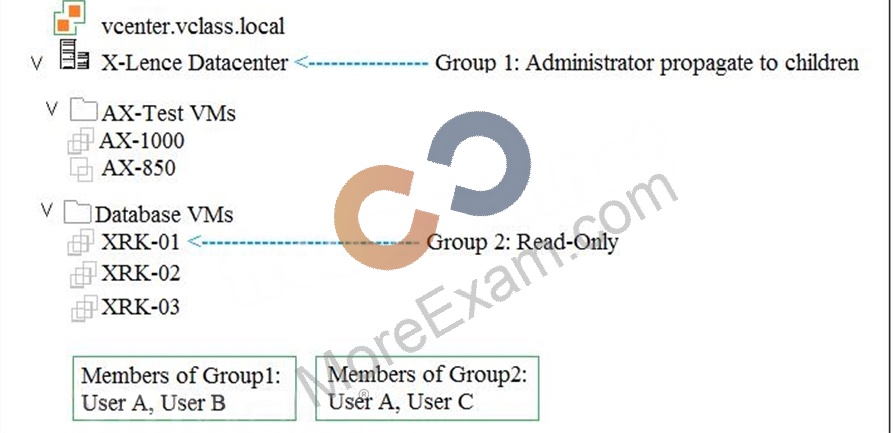
Question29: Which two tasks are allowed in the X-Lence data center? (Choose two.)
Question30: A vSphere administrator has configured software ISCSI port binding in the environment with two VMkernel
ports and four target portals.
How many ISCSI sessions would be created from bound ports to targets?

Question31: Which file extension can export host customization for host profiles?

Question32: A vSphere administrator wants to enable Proactive HA in a vSphere cluster.
What is required to use this feature?

Question33: A vSphere administrator is required to join all strategies ESXi hosts to an Active Directory domain for
enhanced security.
Which utility would accomplish this?

Question34: After installing vCenter, which two identity sources and users are available by default? (Choose two.)

Question35: Using vSphere HA Orchestrated Restart an administrator places the most mission critical VM in the
highest priority. After a host failure, the highest priority VM fails to restart while VMs in high priority restart.
What would cause this to occur?